In partnership with


Wispr Flow turns your voice into clean, ready-to-send writing — speak naturally, it strips the filler and fixes the punctuation. I've used it daily since February 2026 to build this newsletter. Read the full review →
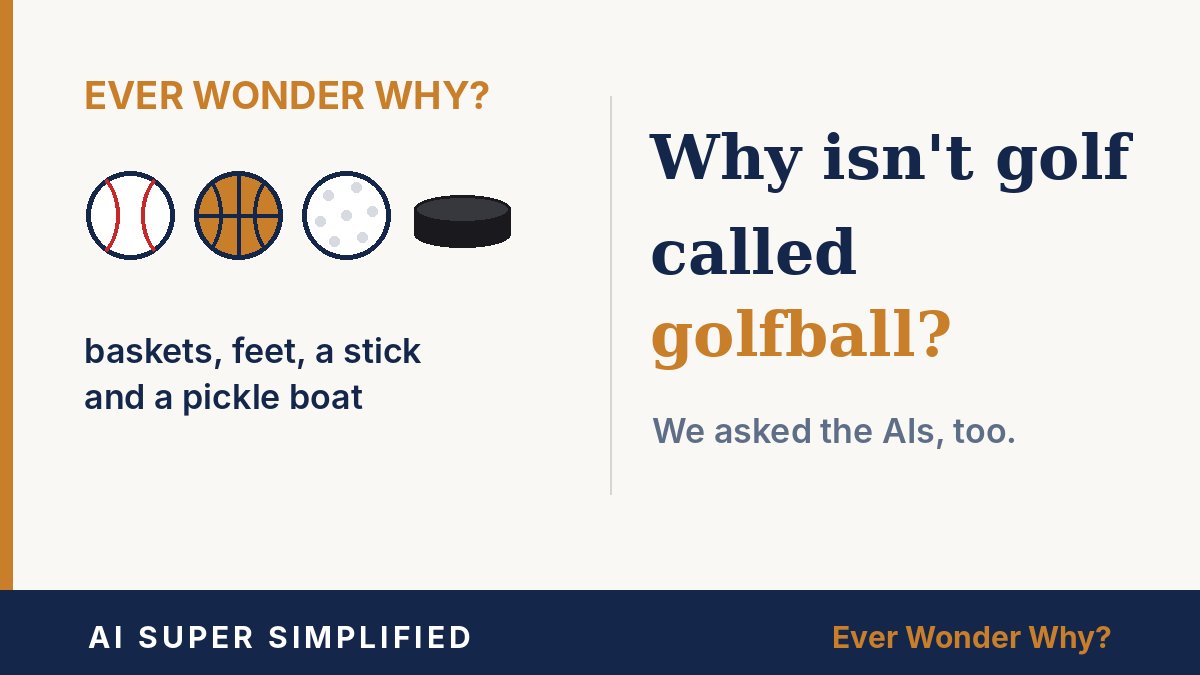
Baseball has a ball in its name. So do basketball, football, handball, volleyball and racquetball. Golf has a golf ball, and somehow it's just... golf.
Welcome to the first Ever Wonder Why?, the weekly edition where we chase one everyday question back to the documents that actually answer it. This week: how sports got their names. Then we hand the most famous myths to the AIs and grade what they say.
Six ways a sport gets its name
The target. Baseball is named for its bases, basketball for a peach basket. In December 1891, James Naismith asked for two boxes to use as goals. The building superintendent had none, but offered “two old peach baskets down in the store room.” It could have been box ball. A student, Frank Mahan, then suggested calling it “Naismith ball.” Naismith said that name “would kill any game.” Mahan's second try: basket ball.
The body part. Football and handball. London's mayor banned football back in 1314 over the “great disturbance in the City” it caused.
The tool. Here's golf. The usual explanation traces it to the Dutch kolf, meaning “club,” though dictionary editors aren't fully convinced. If it's right, a golf ball is really a club ball. Lacrosse is named for its stick too, from the French la crosse.
A shout. Tennis probably comes from the Anglo-French tenez, roughly “take this.” Its 1874 promoter, Major Walter Wingfield, briefly tried calling it Sphairistikè, which the International Tennis Hall of Fame calls “a rather bad use of classical Greek.”
A move. Volleyball began as “Mintonette” and got its new name in 1896.
Pure accident. Pickleball is named after the “pickle boat” in crew races. The famous family dog, Pickles? Born three years after the game was named.
200 Ways To Make Money With AI

Turns out, AI is good for more than writing emails and generating LinkedIn posts. This guide is packed with 200+ actionable ways to build income with AI.
Inside you'll discover:
200 curated AI income ideas for beginners and pros alike
Easy-to-start opportunities you can launch this week
Real world applications for today’s top AI tools
AI powered business models built for today’s economy
Creative ways to turn trends into revenue
AI is changing how people work and how people earn, far beyond the simple “write me an email” prompt. Discover the possibilities and download the free guide to start cashing in today.
The football and soccer mix-up
“Soccer” is a British word. England's Football Association set its rules in 1863, and its game became “Association football.” English students clipped Association into “soccer,” the same way rugby became “rugger.” The British used it for most of the next century. A University of Michigan study found it peaked in British publications between 1960 and 1980, then declined, which the study's author blamed on the word catching on in the US.
Meanwhile, Americans built their own football out of rugby, which left “soccer” for the round-ball game. Even so, America's governing body was the U.S. Football Association until 1945, and “Football” didn't leave its name until 1974. Hockey has the same split: grass in Britain, ice in North America.
Two myths, one very old law
GOLF is not short for “Gentlemen Only, Ladies Forbidden.” The US Golf Association says plainly that the word isn't an acronym. It appears in a Scottish law from 1457 that ordered golf and football “utirly criyt doune” so men would practice archery instead. Merriam-Webster finds no trace of the acronym joke before the late 1980s.
Abner Doubleday did not invent baseball. The National Baseball Hall of Fame, which sits in Cooperstown largely because of his story, says “The Doubleday Myth has been refuted.” He was a cadet at West Point in 1839, the year he supposedly invented it.
Why are so many brands shifting ad spend to CTV?

People spend more time streaming than they do with cable, social media or video games, and advertisers know it. In fact, according to Advertiser Perceptions and Premion's 2026 CTV/OTT Advertiser Survey, 70% of advertisers are raising CTV budgets in 2026, with much of that budget diverted from social advertising.
For marketers who want a presence in streaming, Roku is the obvious place to go, with scale that speaks for itself. With more than 100 million households representing 47% of all streaming time in the US, Roku easily has more reach than every competitor.
With Roku Ads Manager, you can reach viewers across more than 100 premium apps in a single buy. Combine your customer data with Roku's insights to reach only the households you want, then measure and optimize to your heart's content.
Want to give it a try? Unleash your first campaign in just four steps: (1) Create your account, (2) define your objective and target audience, (3) upload creative, and (4) launch.
First-time spenders get a $5,000 match on the first $5,000 spent with code BEEHIIV5K. Terms apply.
We asked the AIs
This week, Gemini and Claude went head to head. Each got the same three questions, word for word, in a fresh conversation with no web search.
Does GOLF stand for “Gentlemen Only, Ladies Forbidden”? Gemini ✅ Claude ✅
Did Abner Doubleday invent baseball? Gemini ⚠️ Claude ⚠️
Why do Americans call it soccer? Gemini ⚠️ Claude ✅
Both knocked down the big myths. Then, in the middle of debunking Doubleday, both repeated a smaller one: that he never mentioned baseball in his letters or diaries. He did. In 1871, as an Army officer in Texas, he asked to purchase “baseball implements for the amusement of the men.”
Gemini also stated, as plain fact, that “football” once meant games “played on foot (as opposed to on horseback).” That's a theory historians still debate.
That's the pattern worth remembering. AI is strongest on the questions that have been answered loudly and often, and shakiest on the quieter details around them. And the shaky detail sounds just as confident as the solid debunk. When a fact is headed for a toast or a bar bet, ask the AI where it came from, then check that source.
On the site: the full scorecard, more sports, and a copy-paste prompt that turns any AI into a careful word detective.
Got a question you've always wondered about? Hit reply and it might be the next Ever Wonder Why?
State of Product reveals what AI still hasn’t solved

80% of product professionals say AI helps them ship faster, but customers aren’t seeing value any sooner. Atlassian’s State of Product 2027 explores the gains AI is delivering and the challenges that remain, from decision-making that hasn’t kept pace to gut instinct overriding customer evidence.
How was today's edition?
— Jerry
AI Super Simplified