
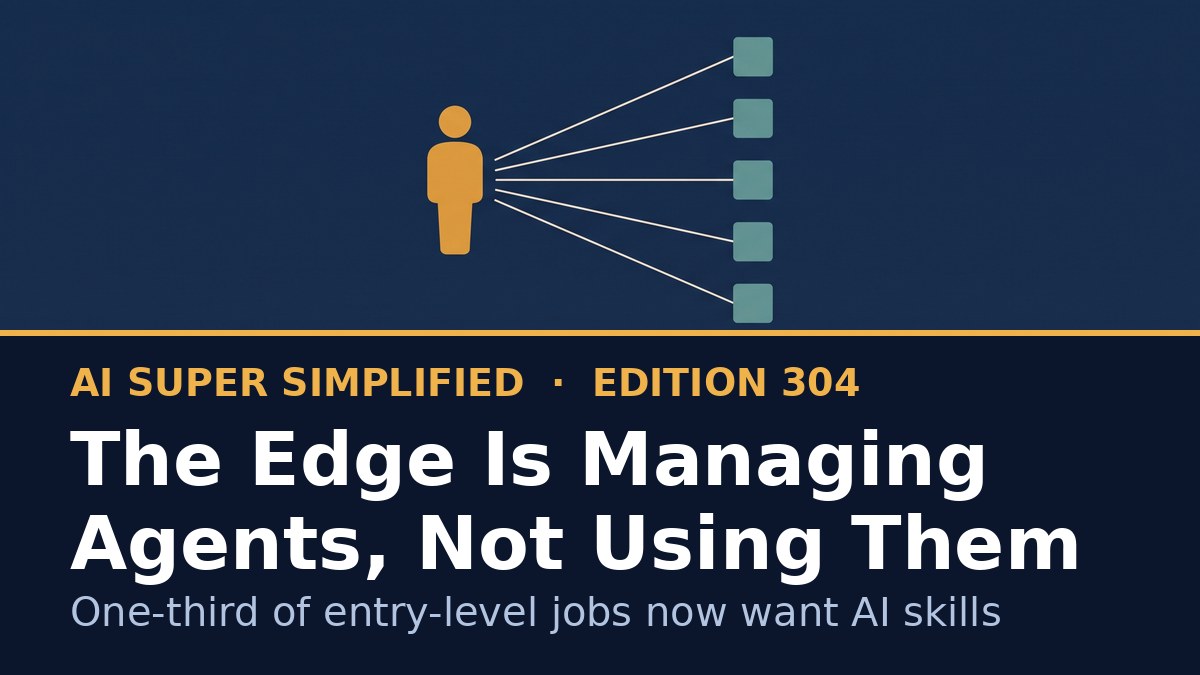

For two years the entry-level story ran in one direction: AI does the junior work, so companies stop hiring juniors. Then in May, The Wall Street Journal ran the opposite headline — companies saying AI is reviving entry-level jobs, not killing them.
Both versions have evidence behind them. The reason they can coexist is the useful part: the entry-level work that vanished and the work that appeared are not the same work.
Harvard Business Review named the job in February. On February 12, 2026, HBR published To Thrive in the AI Era, Companies Need Agent Managers, by Harvard Business School professor Suraj Srinivasan and Salesforce's Vivienne Wei. Their definition: agent managers are "leaders responsible for orchestrating how AI agents learn, collaborate, perform, and work safely alongside humans."
Notice what is absent from that definition — coding, model training, technical depth. It is a specification-and-review job. You decide what the agent should do, you judge whether the output is good, and you own the exceptions it cannot handle.
The demand shows up in the survey data. The National Association of Colleges and Employers fielded its Job Outlook 2026 Spring Update from February 12 to March 17. It found that more than one-third of entry-level jobs now require AI skills, according to employers themselves — nearly triple the share who said so in fall 2025. Nearly triple, in roughly six months.
And here is the number that keeps this honest. Indeed's Hiring Lab published an analysis on July 8, 2026 by economist Guillermo Gallacher: US software development postings have grown almost 15% since Claude Code launched in late February 2025, while overall postings fell 7% over the same period. A real reversal.
But 71% of that increase in software development postings between May 2025 and May 2026 came from senior roles.
So the demand is real and it is lopsided. Postings came back — mostly above the entry line. Anyone telling you the squeeze is over is reading half the data. Anyone telling you AI ended entry-level work is reading the other half.
Two Minutes to Know What Slow Billing Is Costing You

Most SaaS finance teams know their billing process is slow.Most SaaS finance teams know their billing process is slow. Few know what it's costing them.
The Tabs Billing Lag Calculator puts a dollar figure on it in two minutes — benchmarked against top SaaS companies.
Why managing agents differs from using AI. Using AI is a single-turn transaction: ask, receive, use or discard. The skill ceiling is phrasing, which is why it commoditized so fast.
Managing agents is supervisory work. You decompose a task into handoff-sized pieces. You write a specification precise enough that success is checkable. You build a review step, because you are now accountable for output you did not personally produce. And you know what should never leave your desk at all.
Anthropic's Economic Index, which measures observed usage rather than stated usage, splits almost evenly for its May 2026 period: 51.4% augmentation against 48.6% automation. Roughly half of real usage already looks like delegate-and-check rather than ask-and-answer.
A July 2026 HBR research piece by Jim Doucette and Vishal Gaur put the employer side plainly: generative AI is changing what employers want from knowledge workers not by replacing expertise but by raising the bar for it. You cannot review what you do not understand.
What to do this week. Pick one recurring task and write a real specification for it — the input, what good output looks like, the failure cases, and how you will check. If you cannot write the check, you cannot safely delegate the task. Run it three times and review it like a manager: not "is this good?" but "would I sign my name to this without reading every line?" Then keep a list of what you would never hand over. Anyone can say what AI does well; saying precisely where it should not be trusted is judgment — and judgment is the part that is not being posted away to senior roles.
The market did not get easier. But the skill that closes the gap is not "learn AI" in the generic sense every posting now lists. It is the narrow, demonstrable ability to hand work to a system, verify what comes back, and own the result — a management skill you can practice before anyone gives you the title.
— Jerry