In partnership with


Wispr Flow turns your voice into clean, ready-to-send writing — speak naturally, it strips the filler and fixes the punctuation. I've used it daily since February 2026 to build this newsletter. Read the full review →
On November 3, voters in 10 states decided 41 local ballot measures about data centers. In 40 of them, voters sided with limiting development, according to Ballotpedia.
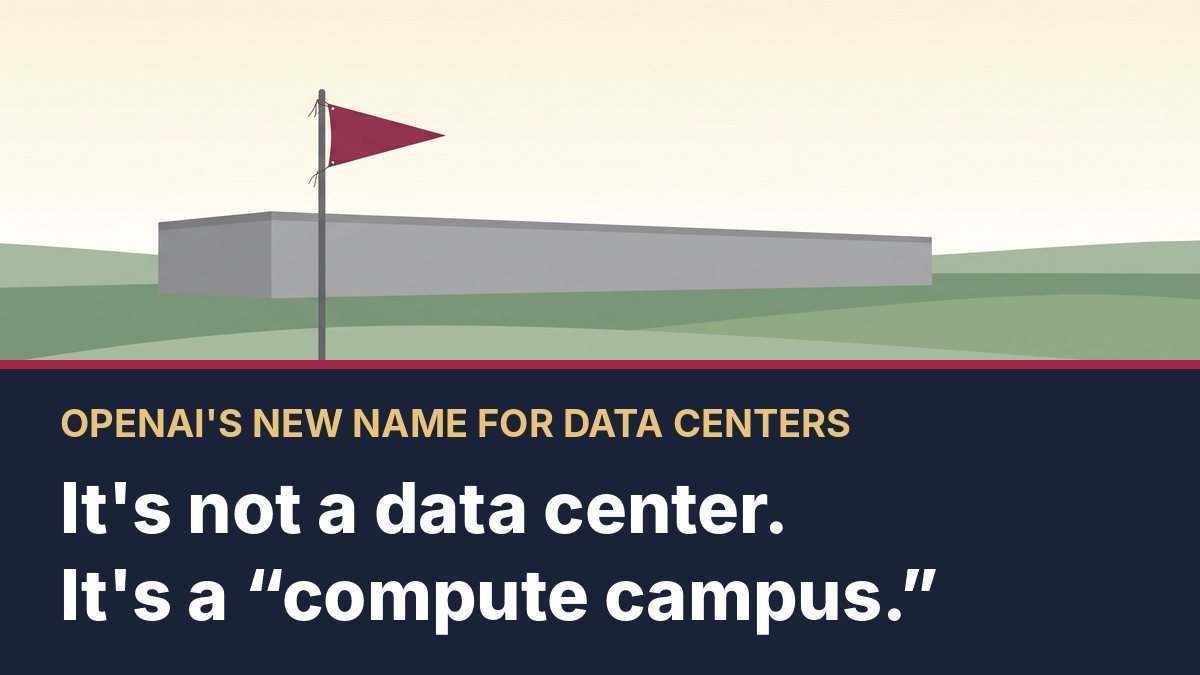
Two days later, OpenAI unveiled a new name for the buildings. They're not data centers anymore. They're "compute campuses."
The timing looks like a reaction, but OpenAI says the plan had been in the works since August, and Axios reported the new name before Election Day. Either way, the name came with promises. Some of them are worth holding OpenAI to.
What OpenAI is saying. OpenAI's new Compute Campus Policy Blueprint says AI training data centers are "more accurately described as compute campuses." Its argument: an AI data center "in fact isn't big box in a pasture to store data with few economic benefits for the community." Over a campus's 30-year life, OpenAI says, the hardware gets upgraded every three to five years, which keeps local technicians, electricians and suppliers busy long after construction ends.

Most AI newsletters get skimmed, then archived. TLDR AI is the one worth opening. It's a free daily email curated by engineers from OpenAI, Adobe, and Google DeepMind. They read everything, then send the model releases, research, and tools that actually matter. It’s a 5-minute read, delivered every weekday morning.
The promises, in plain English. OpenAI says it will apply these to campuses it owns and operates:
No required NDAs. OpenAI won't require public officials to sign nondisclosure agreements, except in narrow cases like security or trade secrets. It says it voided the NDAs at its Effingham County, Georgia, site in July.
Public numbers. Site-by-site noise measurements, energy use and water use, which OpenAI says it will post on its website.
Your power bill. "Large electricity customers, like data centers, must pay their own way," the blueprint says. In Georgia, OpenAI agreed to pay the full cost of the grid equipment serving its Effingham campus, and to let Georgia Power cut up to 1,000 megawatts of its power when demand peaks. Georgia Power projects that its new large customers, OpenAI among them, will save typical home customers at least $15 a month starting in 2029, if projected growth holds.
Water. Effingham will use a closed-loop cooling system that recirculates water, which OpenAI compares to a car radiator.
Local money. $80 million in committed Effingham community investments beyond taxes, including a $4.8 million grant for free school meals for all 14,000 county students.
OpenAI also asks lawmakers to make some of this the law for everyone: bar developers from requiring officials to sign NDAs, require public water, noise and energy reports, and have state and local governments publish their tax-break deals.
The fine print. The commitments cover "OpenAI-owned and operated compute campuses moving forward." Many big AI sites are built by partners. Take "The Barn" in Saline Township, Michigan, a more-than-1-gigawatt site Related Digital is building for Oracle and OpenAI. The township board voted 4-1 in September 2025 to deny the rezoning. The developer sued two days later, and the township settled weeks after that. Protesters were still rallying there in July 2026. OpenAI hasn't said whether its new commitments reach sites like that one.
Why now. Data Center Watch, which tracks local opposition, counted at least 75 projects worth about $130 billion blocked or delayed in the first three months of 2026, and at least 45 worth nearly $68 billion in the next three. OpenAI's chief global affairs officer, Chris Lehane, wrote on LinkedIn that "voters made their concerns about data centers clear in this week's elections." Amazon announced its own pledge of more than $1 billion over five years for data center communities last month.
The skeptics. "You can't rename your way out of a problem," brand strategist Allen Adamson told Fortune. "A campus implies a university, not a warehouse." Brookings' Mark MacCarthy was blunter: "There's no trust left."
What this means for you. If a data center is proposed near you, OpenAI just handed you a free checklist. Hold any developer to it. Ask who will own and run the site, whether local officials signed NDAs, where the water, noise and power reports will be posted, who pays for grid upgrades, and whether the tax-break terms are public. A new name costs nothing. Those answers don't.
On the site: a tap-through checklist that scores any proposed data center against OpenAI's own standards, and a copy-paste prompt that turns your local project into the questions to ask at the next public meeting.
50 Excel Hacks That Make Spreadsheets Work For You

Most Excel users waste hours on tasks that take experts minutes. The difference is not talent. It is knowing the right shortcuts. These 50 Excel hacks from Kenji Explains cover the functions, formulas, and workflows that make spreadsheets work for you instead of against you.
Each one comes with step-by-step instructions and ready-to-use templates. Subscribe to Marketing Against the Grain and get all 50 free.
Here's what you'll get:
Time-saving shortcuts that eliminate the most common formula frustrations
Interface essentials most users never discover on their own
Game-changing functions for data analysis, automation, and visualization
Guided practice template so you can apply every hack immediately
The people who are fast in Excel are not smarter. They just stopped fighting the tool.
Get 50 Excel Hacks free when you subscribe to Marketing Against the Grain today.
How was today's edition?
— Jerry
AI Super Simplified