
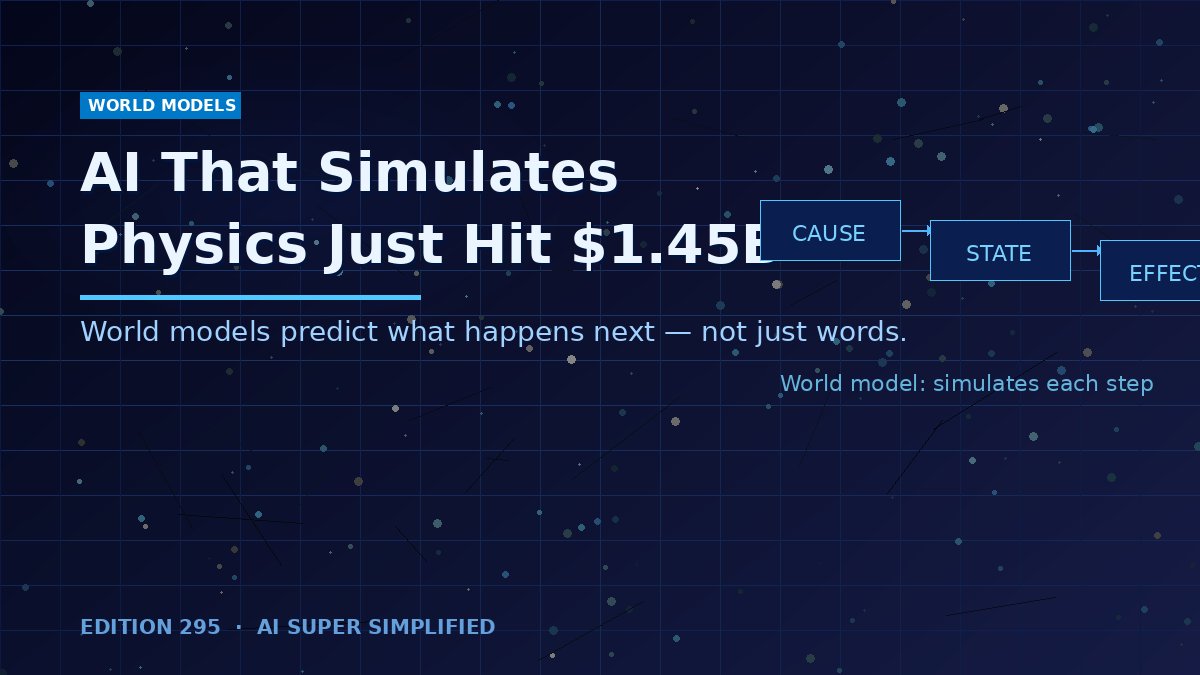
Every few years, a category of AI transitions from research papers to funded companies shipping products. Language models hit that inflection point around 2020. World models — AI that predicts the next state of reality, not the next word — may be hitting it now.
What changed: On June 17, 2026, a Palo Alto lab called Odyssey closed a $310 million Series B at a $1.45 billion valuation. Backers include Amazon, Google Ventures, AMD Ventures, EQT, and In-Q-Tel — the CIA's venture capital arm. Total raised to date: $337 million.
The distinction that matters: A language model learns from text and predicts what word comes next. A world model predicts the next state of a physical environment — position, velocity, force, consequence. Odyssey CEO Oliver Cameron: "World models represent a new class of foundation model — AI that can understand and simulate the world itself."
Four new models: Odyssey launched four products alongside the announcement. Odyssey-2 Max handles general physics-accurate world simulation. Starchild-1 is the headline: the first real-time multimodal world model that generates synchronized audio and video simultaneously while responding to live input — text, speech, or actions. Earlier world models handled video only; simultaneous audio and video in real time is the technical breakthrough. Agora-1 puts multiple humans and AI agents into the same simulation at once. PROWL-1 is a reinforcement learning framework where agents train by making mistakes inside simulated environments.
The Amazon deal: Amazon's investment comes with a strategic agreement to optimize Odyssey's models on AWS Trainium chips, Amazon's direct answer to Nvidia's AI hardware dominance.
The team: CEO Oliver Cameron co-founded Voyage (acquired by GM's Cruise) and served as Cruise's VP of Product. CTO Jeff Hawke was an engineer at UK self-driving startup Wayve. The broader team comes from DeepMind, Tesla, Waymo, Meta, and Apple.
Not alone: In February 2026, World Labs — founded by AI pioneer Fei-Fei Li (who built ImageNet) — raised $1 billion backed by Autodesk, Andreessen Horowitz, Nvidia, and AMD. Multiple well-funded labs are racing the same category at once, which is typically what you see when technical barriers have dropped enough to make a race worth entering.
Odyssey's framing: They are calling this the "GPT-3 moment" for world models — the same inflection point language models hit in 2020, right before they became something every company was trying to use. That framing comes from the company itself, not independent analysts, but the funding pattern is consistent with it.
The full edition on the site includes an interactive cause-and-effect explorer and a copy-paste prompt that lets you experience the difference between predicting words and predicting what happens next in physical reality.