
Wispr Flow turns your voice into clean, ready-to-send writing — speak naturally, it strips the filler and fixes the punctuation. I've used it daily since February 2026 to build this newsletter. Read the full review →
Most of us have a bottle of balsamic vinegar somewhere in the kitchen. You pour it over a salad, maybe drizzle some over tomatoes and mozzarella, and that's about it.
I thought I understood balsamic too. Then, on our trip through Italy this summer, we visited Acetaia Giusti in Modena — a house that has been making balsamic vinegar since 1605, now run by the seventeenth generation of the same family.
What I found out there: good balsamic is much closer to wine than it is to ordinary vinegar. There isn't one best bottle. There are different bottles for different jobs.
It starts with grapes, not vinegar
Real balsamic from Modena starts with grape must — freshly pressed juice, sugars and skins and all, predominantly Trebbiano and Lambrusco. That juice is cooked slowly until the water evaporates and what's left is sweeter, darker, and more concentrated.
Then it goes into wood, and the wood shapes it. Giusti's aging rooms hold barrels that have been in use for decades and in some cases centuries. Aroma comes out of the wood while evaporation keeps concentrating what's inside.
Grape, region, barrel, time. That's a wine story.
The Future of AI in Marketing. Your Shortcut to Smarter, Faster Marketing.

This guide distills 10 AI strategies from industry leaders that are transforming marketing.
Learn how HubSpot's engineering team achieved 15-20% productivity gains with AI
Learn how AI-driven emails achieved 94% higher conversion rates
Discover 7 ways to enhance your marketing strategy with AI.
What I had wrong about the medals
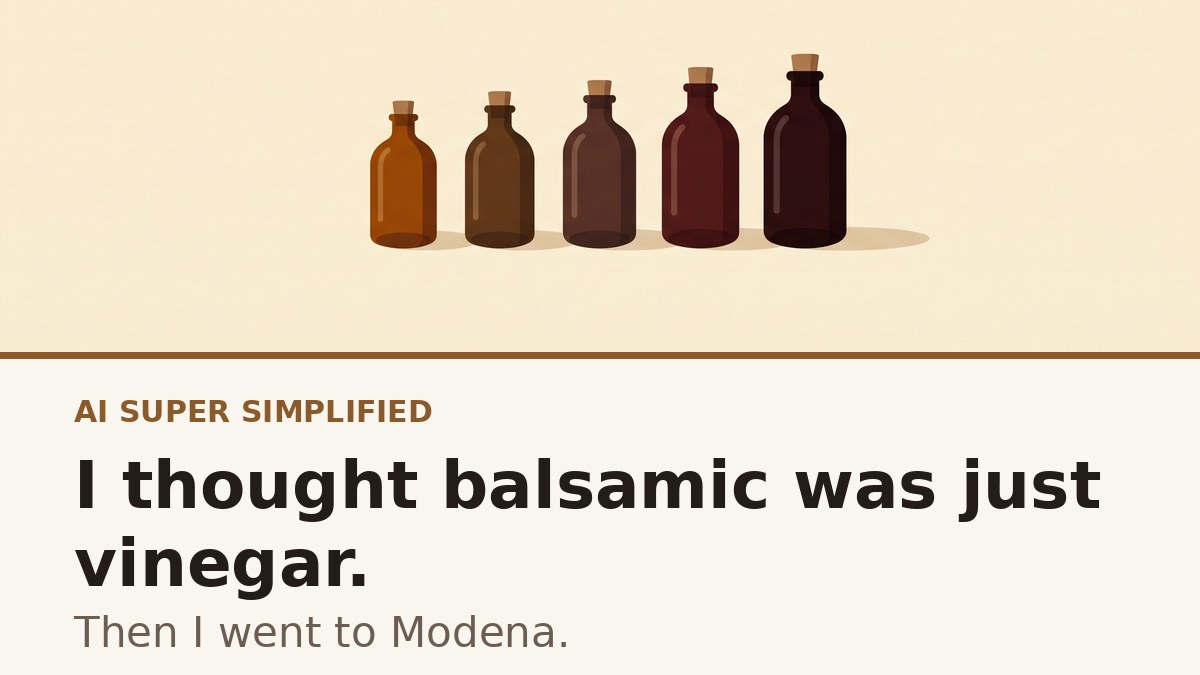
Giusti's Historical Collection has five levels: 1 Silver Medal, then 2, 3, 4, and 5 Gold Medals. I assumed that was an age scale — 1 youngest, 5 oldest.
Close, but it misses the point. Giusti describes them as five balsamics made from different recipes and aging processes, classified by a progressive number of medals. The aging does go up as you climb — but the recipe changes too, so it isn't just the same liquid sitting in wood longer.
And the medals aren't a rating system Giusti invented. They commemorate real awards: the house won 14 gold medals at World Exhibitions in the late 1800s, and its bottles carry the coat of arms of the Royal House of Savoy.
Which bottle does which job
1 Silver Medal — cooked grape must plus aged wine vinegar, French oak, minimum three years, around 6% acidity. Bright and sharp. This is the one you actually cook with: vinaigrettes, marinades, pan sauces, reductions.
2 Gold Medals — more body, balanced, with mature fruit, licorice and black pepper. If you want one good balsamic in the kitchen, this is probably it.
3 Gold Medals — made from sweet, sun-dried grapes on an early-1900s family recipe. Denser and sweeter, honey and vanilla. This is the one I'd hand someone who wants to understand what good balsamic tastes like. Try it on Parmigiano, on strawberries, or on vanilla gelato. Yes, gelato.
4 Gold Medals — the creamiest and sweetest of the five. Syrupy, mildly peppery, a smoky honey finish. Finishing only, by the drizzle.
5 Gold Medals — plum, black cherry, sweet spice, the smell of old wood, and a finish that goes on and on. A few drops on good cheese, or straight off a spoon.
The rule that actually saves you money
If you're making a marinade — olive oil, garlic, herbs, mustard, salt, pepper — there is almost no reason to pour the 5 Gold Medals into it. You're paying for aroma and complexity that vanishes under everything else in the bowl. Use the 1 or the 2.
But put out a chunk of 36-month Parmigiano Reggiano, and now the 4 or the 5 earns it. Two drops changes the whole bite.
Same logic as cooking with wine: right bottle, right job.
There's also a level above all five — Aceto Balsamico Tradizionale di Modena DOP, legally a different product, made from cooked must only with no wine vinegar, aged in a battery of progressively smaller barrels. The younger grade must mature at least 12 years. The top grade, at least 25.
The part that's actually about AI
Twenty years ago I'd have come home, put the bottles in a cabinet, and forgotten what the person at Giusti told us.
Instead I photographed the bottles and asked: explain these to me. Then: what's the difference? Then: which foods go with each? Then: why does barrel aging matter? Then: explain it like wine so it clicks.
A one-hour tasting became something I was still learning from weeks later.
That's the use I keep coming back to, and it's not where most people start. Don't just look something up — keep asking follow-ups until it genuinely makes sense. Take pictures. Ask what you're looking at, why it matters, how to use it, and how it compares to something you already understand.
That last question does more work than all the others combined.
Sometimes it starts with a bottle of vinegar.
Free email without sacrificing your privacy

Gmail tracks you. Proton doesn’t. Get private email that puts your data — and your privacy — first.
— Jerry
AI Super Simplified