In partnership with


Wispr Flow turns your voice into clean, ready-to-send writing — speak naturally, it strips the filler and fixes the punctuation. I've used it daily since February 2026 to build this newsletter. Read the full review →
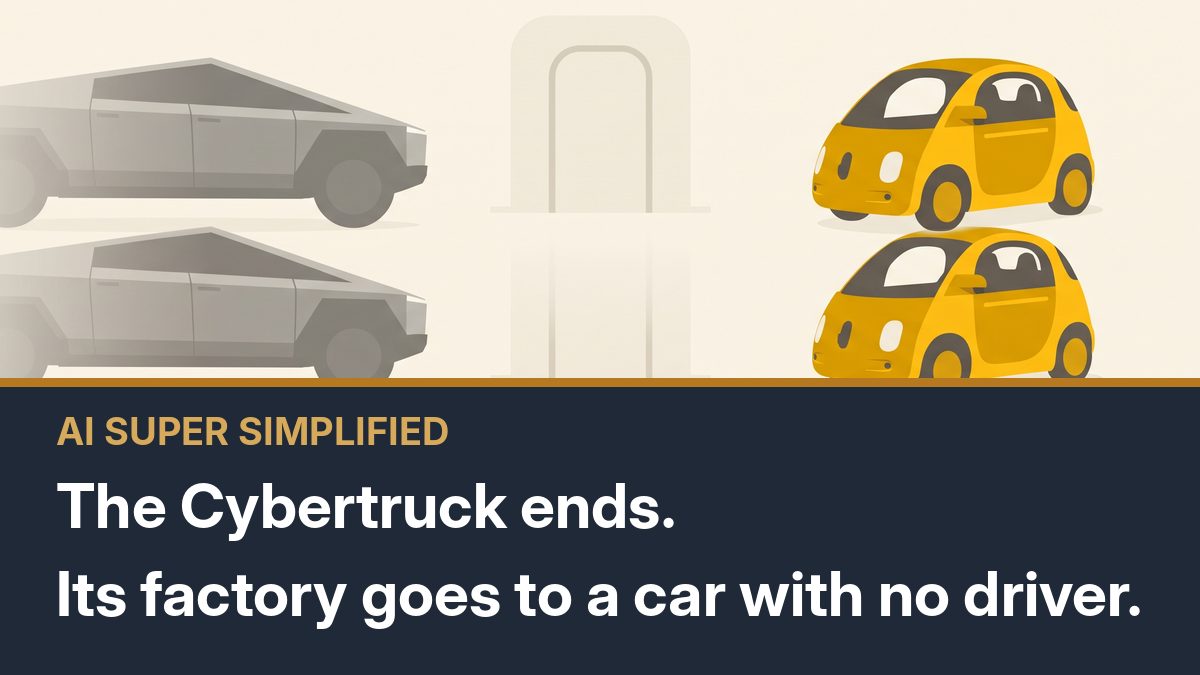
Tesla will stop building the Cybertruck at its Texas factory around the middle of 2027. The space is going to the Cybercab, a two-seat robotaxi with no steering wheel and no pedals. Its only driver is Tesla’s AI.
“Tesla will be winding down production of the Cybertruck at Gigafactory Texas around the middle of next year to make room for increased Cybercab production,” Elon Musk posted on X in early November.
A truck people drive is making way for a car that drives itself. That’s the clearest sign yet of where Tesla thinks its future is.
What was promised. At the 2019 unveiling, Tesla pitched a stainless-steel pickup starting at $39,900, with a top version good for more than 500 miles on a charge. The event is best remembered for the “armor glass” windows that cracked on stage when Tesla’s design chief threw a metal ball at them. Musk predicted the truck would eventually sell 250,000 a year.
What showed up. Deliveries began in late 2023, years late. The first trucks started near $80,000, and the cheapest version Tesla ever offered, in February 2026, cost $59,990 for 10 days. No version came close to 500 miles on its own battery; the longest-range version is EPA-rated at about 335. Federal regulators list 11 voluntary recalls.
The sales gap. Tesla doesn’t report sales by model, but Kelley Blue Book estimates U.S. buyers took 38,965 Cybertrucks in 2024 and 20,237 in 2025, about 8% of Musk’s yearly goal. Through the first nine months of 2026, sales fell another 28%. Part of the slide has been tied to backlash over Musk’s 2025 role in the Trump administration’s DOGE cost-cutting effort.
The voice-to-text app that built its own speech model

Most dictation apps are a wrapper around someone else's speech model. Wispr Flow trained its own.
It's called Canto, and it was built for the way people actually talk to AI: thinking out loud, changing direction mid-sentence, half-whispering in an open office.
Wispr tested it on 10 hours of real dictations from more than 2,300 speakers. Canto had the lowest word error rate of every model tested, including models from Google, OpenAI, AssemblyAI and Deepgram. That means your prompts to ChatGPT, Claude and Cursor come through the way you said them.
Talk naturally in any app and Wispr Flow types clean, formatted text, 4x faster than typing.
Where the factory is going. The Cybercab went into production earlier this year, and Tesla began paid rides in a small Cybercab fleet in Austin in September. Texas DMV figures cited by Reuters show about 570 of the more than 1,200 Tesla robotaxis in the state are Cybercabs. The Cybertruck’s lead engineer, Wes Morrill, summed it up on X: “Cybertruck was an incredible technology development platform and lives on through Cybercab.”
The same AI is already in your driveway. The Cybercab runs on the same AI as FSD (Supervised), the driver-assist feature Tesla sells for the Model 3 and Model Y. Version 14 steers, changes lanes and parks itself while the driver supervises. This summer, Tesla brought a “Lite” version to older cars with the HW3 computer, using AI training rather than new hardware to close much of the gap with new models. It runs on cameras, not lidar, and Tesla’s manual still warns it may not work as intended in heavy rain, snow or fog.
The catches.
Rides cover Tesla’s service zone in Austin, not the country.
The National Highway Traffic Safety Administration opened an audit in September into whether Tesla properly certified the Cybercab under federal safety standards.
Musk didn’t say whether the truck will be built somewhere else or end entirely.
What it means for you. Tesla already ended the Model S and Model X this year to make room for Optimus robots, and Musk says the new Roadster won’t enter production until 2028. After the Cybertruck, the Model 3 and Model Y will be the only Teslas you can buy and drive yourself. The company is putting its factories behind AI, robots in California and robotaxis in Texas, and how fast that pays off depends on how quickly each state lets driverless cars carry the public.
The bigger question for most of us isn’t Tesla. It’s whether owning a car will still beat riding in a few years. You can start working that out now, with your own numbers.
On the site: a free copy-paste prompt that runs the own-or-ride math for your household, a quick calculator, and every source behind this edition.
The holiday streaming season is almost here

Are you ready? As revealed in our holiday playbook, Roku Ads Manager lets you easily set up, measure and optimize your self-serve holiday ad campaign. You can even create a shoppable ad unit that lets streamers buy directly from their remote.
How was today's edition?
— Jerry
AI Super Simplified