
Wispr Flow turns your voice into clean, ready-to-send writing — speak naturally, it strips the filler and fixes the punctuation. I've used it daily since February 2026 to build this newsletter. Read the full review →
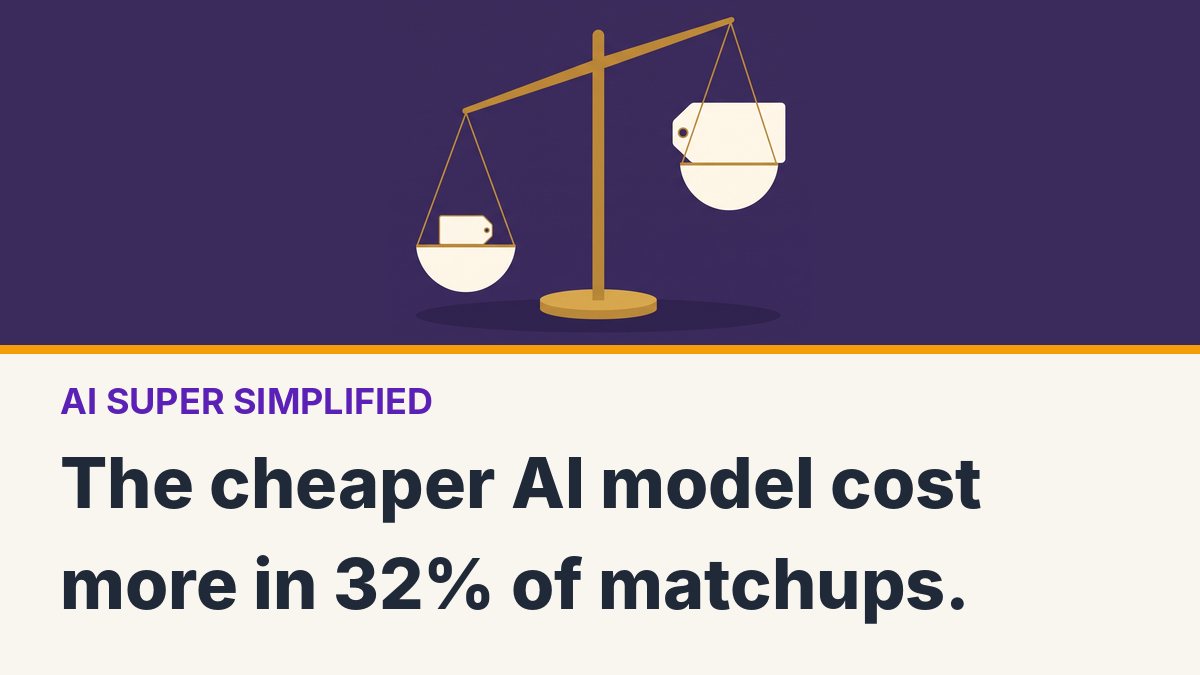
The AI model with the lower price tag turned out to cost more in nearly one of every three head-to-head comparisons.
That’s the finding of a study by researchers at Stanford, UC Berkeley, Carnegie Mellon and Microsoft Research. They ran eight leading AI models through 12 kinds of work and compared what each was supposed to cost with what it actually cost. On Monday, The Wall Street Journal paired it with a survey finding that only 11% of companies can predict their AI spending within 10%.
If you pay for AI by usage, or your company does, the price list isn’t telling you what you’ll spend.
What the researchers found
The team tested eight “reasoning” models, the kind that work through a problem step by step before answering, on competition math, science questions, coding and multi-step agent work.
Then they lined the models up in pairs. In 32% of those pairings, the model with the lower listed price ran up the higher total cost. In the most extreme case the gap was 28 times.
One example from the paper, using two of the models tested: Google’s Gemini 3 Flash is listed at a price 80% lower than OpenAI’s GPT-5.4. Across all the tasks in the study, it actually cost 38% more.
“Price alone should not be used to infer which model is actually cheaper,” said Lingjiao Chen, the paper’s lead author.
200+ Proven Ways to Make Money With AI in 2026

The next wave of millionaires will be people who figured out how to make AI work for them.
The window to get ahead is still open. But not for long.
Here are 200+ proven ways to make money with AI in 2026.
Sign up for Superhuman AI, the free daily newsletter read by 1M+ professionals, and get instant access to all 200+ ways to profit from AI this year.
Why the cheap one can cost more
AI companies bill by the token, roughly a piece of a word. With reasoning models you also pay for the tokens the model uses to think before it answers. You usually never see that thinking. You do pay for it.
On the very same question, one model might use 900% more thinking tokens than another, or take 10 times as many steps. A model that charges a fifth as much per token but burns seven times the tokens is the expensive one.
Why nobody can budget for it
The researchers ran the same question through the same model more than once and saw the thinking tokens vary by as much as 9.7 times. Some of the cost simply can’t be predicted in advance.
Companies are feeling it. In a survey of 396 companies by Mavvrik and Benchmarkit, only 11% said they could forecast AI spending within 10%, down from 15% in the 2025 survey. Mavvrik reports that 62% had an unexpected AI cost change a business decision in the past year, with fallout including board escalations (40%) and delayed or cancelled AI projects (25%). (Mavvrik sells AI cost-tracking software, so weigh that. The independent research points the same way.)
What it means for you
On a flat monthly plan? You’re mostly fine. Unless you’ve switched on extra-usage credits, your bill doesn’t change. This is about pay-per-use: company accounts, AI agents, and coding tools billed by the token.
Compare the total, not the price list. Run 20 real tasks from your own work on two models and see what each run cost.
Budget a range, not a number. Plan for the high end.
Put a ceiling on it. If your provider offers spending limits or alerts, turn them on.
Don’t write off the premium model. Sometimes it finishes with less thinking or fewer steps and comes out cheaper.
The bigger picture
For the same level of capability, AI keeps getting cheaper per token. But nobody buys tokens. You buy finished work, and that price depends on how hard the model has to think to get there.
On the site: a calculator that shows when the “cheap” model stops being cheap, the source for every number, and a copy-paste prompt that helps you test which model is really cheaper for your work.
State of Product reveals what AI still hasn’t solved

80% of product professionals say AI helps them ship faster, but customers aren’t seeing value any sooner. Atlassian’s State of Product 2027 explores the gains AI is delivering and the challenges that remain, from decision-making that hasn’t kept pace to gut instinct overriding customer evidence.
What job will you give ChatGPT first?
— Jerry
AI Super Simplified