

Wispr Flow turns your voice into clean, ready-to-send writing — speak naturally, it strips the filler and fixes the punctuation. I've used it daily since February 2026 to build this newsletter. Read the full review →
On Oct. 6, OpenAI posted 722 math papers to GitHub at once.
They came from an AI model the company hasn't released or even named. Together they claim answers to more than 300 open problems, some of which had stumped mathematicians for decades — including partial results tied to three of the remaining Millennium Prize Problems, the most famous unanswered questions in math, though none fully solves one.
The reaction split the field. Rutgers professor Alex Kontorovich said one result would be "an instant Fields Medal" if a human had done it. Even a researcher at rival Anthropic called the release the most significant moment in mathematical history. But a day later, UT Austin computer scientist Scott Aaronson wrote that no human appeared to have understood just about any of the proofs yet.
Both things are true. That's the story.
How we got here. A month earlier, on Sept. 8, OpenAI said roughly 10,000 AI agents running the same unreleased model had cracked the Navier–Stokes problem — one of seven Millennium Prize Problems, each worth $1 million — in about 88 hours. Only one of the seven had ever been solved before. OpenAI said it won't claim the prize. An NYU mathematician working on a related problem with an Anthropic researcher said OpenAI had built on their work without credit. OpenAI denied it.
Three days later, 25 winners of the Fields Medal, math's highest honor, signed an open letter saying the goals of AI companies and mathematicians are "severely misaligned." Racing to solve famous problems as a model benchmark, they argued, skips the part that matters: humans understanding why the answer is true. On Sept. 21, OpenAI announced an independent advisory group of nine leading mathematicians, hosted at the Institute for Advanced Study in Princeton, to advise AI labs on how to release this kind of work.
What's actually in the box.
722 papers in 372 groups of related results. OpenAI pulled three the next day over a sign error and revised 14 others.
About 4,000 problems tried. The released results are the ones that cleared OpenAI's bar.
About three hours of computing per result, measured in ChatGPT Pro "thinking" time.
About 42% of the main results have Lean proofs. Lean is a language where a computer verifies every logical step. OpenAI's own repository warns that some of the unchecked ones "could have issues."
The headliners: a "quasi-Riemann hypothesis" (a partial step toward the famous prime-number problem, not the $1 million version), the Unique Games Conjecture from computer science, a special case of the Hodge conjecture, and a decades-old question about "free group factors."
7 Stocks You May Never Need to Sell

Buying a stock is easy. Finding one you may never need to sell is harder.
This free report reveals seven blue-chip companies selected for financial strength, durable demand and long-term potential to hold up when markets turn ugly.
One paper, up close: π, settled.
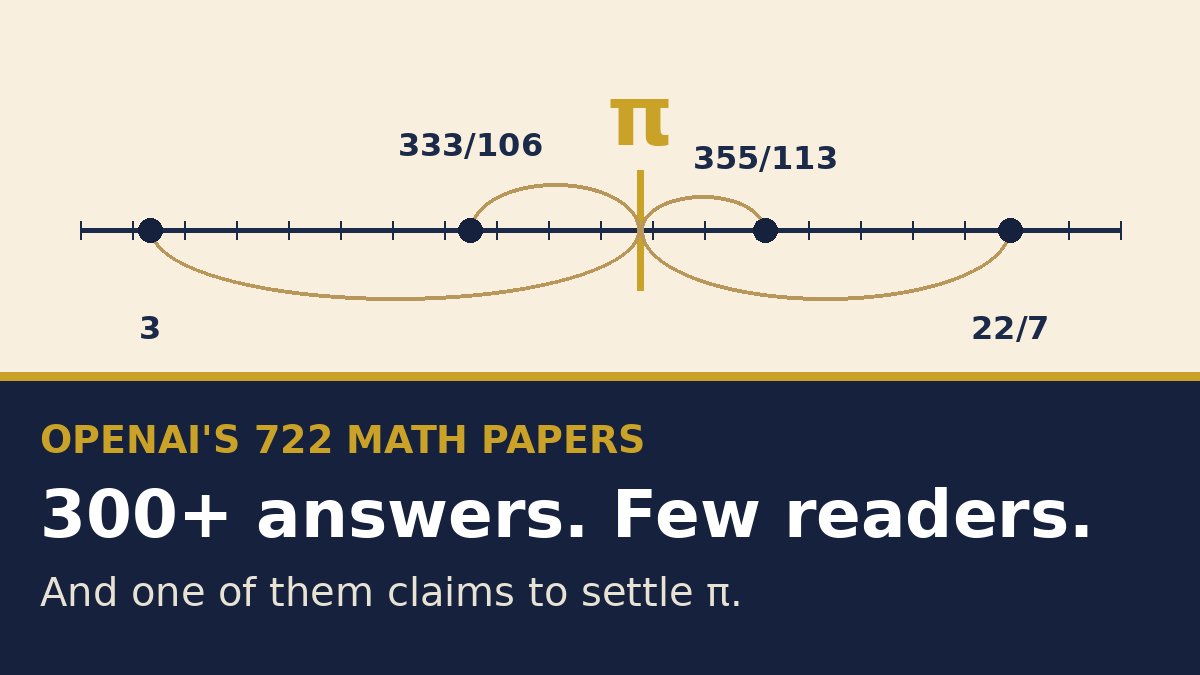
Of all 722, this is the one we'd show you. You know π: 3.14159… It never ends and never repeats, so no fraction equals it exactly. But fractions can get close. 22/7 is off by about 0.001. 355/113 is off by less than 0.0000003, which is absurdly good for a fraction with a three-digit bottom number.
So mathematicians ask a sharper question: how close can fractions ever get to π, compared with how big their bottom number is? For a number like π there's a floor: you can always find fractions that get within roughly 1 divided by the bottom number squared. A number whose fractions can't beat that floor by any real margin has an "irrationality exponent" of 2. Some strange numbers let fractions get much closer, and the question was whether π is secretly one of them.
Everyone believed π sat right on the floor, at 2. Nobody had a proof mathematicians accepted. The best peer-reviewed bound, from 2020, could only say π's number was no worse than about 7.1.
The AI's paper claims it is exactly 2. OpenAI says the main result has been formalized in Lean, though the repository still marks the review of its Lean proofs as "unchecked." Mathematicians are still reading the paper. As a bonus, the paper says this settles a famous puzzle called the Flint–Hills series, which asks whether adding up 1/(n³ sin² n) forever lands on a finite number. Its answer: yes.
The part that made us say wow. OpenAI published a 42-page summary of how the model got there, and it wasn't even aiming for 2. It was trying to get below 2.5, the line that settles the Flint–Hills puzzle. Page after page, it tries an approach, finds the cost that kills it, and moves on. One of its own notes reads: "This kills approach by dimension alone." It finally claimed to squeak under the line at 62/25, or 2.48. Then it noticed something in its own formula: push one setting toward its limit and the exponent slides toward 2. In a separate attempt, it went back and claimed the floor itself.
Read it yourself: the paper (23 pages) and the model's reasoning summary.
The catch: the checkers can't keep up. Dana Moshkovitz, a UT Austin researcher who spent years working toward the Unique Games Conjecture, texted that the AI's paper was "so horribly written that it's impossible to read it without AI help," in messages Aaronson posted on his blog. An OpenAI spokesperson said many of the results aren't yet understood by OpenAI's own mathematicians.
The advisory group had asked AI labs, among other things, to publish the model name and the prompts behind each result, and to stop testing advanced problems on private models at all. OpenAI published 10 summaries of the model's reasoning and average compute figures. It did not publish prompts, it hasn't released the model, and it said it will keep testing internal models on math. A new group calling itself the Association for Human Mathematics urged mathematicians to stop working with OpenAI. The advisory group itself said its involvement isn't an endorsement of the results.
What it means for you.
"Verified" is now a word to question. Ask what was checked, and by whom. Here, about four in ten main results have computer-checkable proofs, and few have been fully checked by people yet. Ask the same thing about any AI report that lands on your desk.
Checking is the new bottleneck, at work too. An AI wrote 722 papers faster than the world's best experts could read them. Your version is the 30-page AI report your team has to sign off on. The hard part moved from writing to reviewing.
Don't scramble over your passwords or crypto. Some crypto voices warned that AI math could weaken encryption. Nothing in OpenAI's release attacks the math that protects wallets and websites, and Ethereum co-founder Vitalik Buterin advised people not to rush to move funds.
This is headed for the tools you use. OpenAI says it's working to release the model. Expect sharper math and logic in everyday AI — and more confident answers that still need checking.
On the site: an interactive where you hunt for fractions that hug π and watch the floor at 2 appear, the source behind every number, and a copy-paste prompt that turns any long AI answer into a check-it-yourself list.
Turn today's calls into tomorrow's proposal

Wispr Flow Notetaker brings your meetings into Claude or ChatGPT through a built-in connector. Ask for a proposal draft or a deal recap, and your AI works from an accurate record of what was said.
How was today's edition?
— Jerry
AI Super Simplified