
Wispr Flow turns your voice into clean, ready-to-send writing — speak naturally, it strips the filler and fixes the punctuation. I've used it daily since February 2026 to build this newsletter. Read the full review →
Students are back on campus this month carrying a question the class of 2015 never packed: will my major still make sense by graduation?
It is no longer just a mood — it is in the enrollment data.
The anxiety is measurable
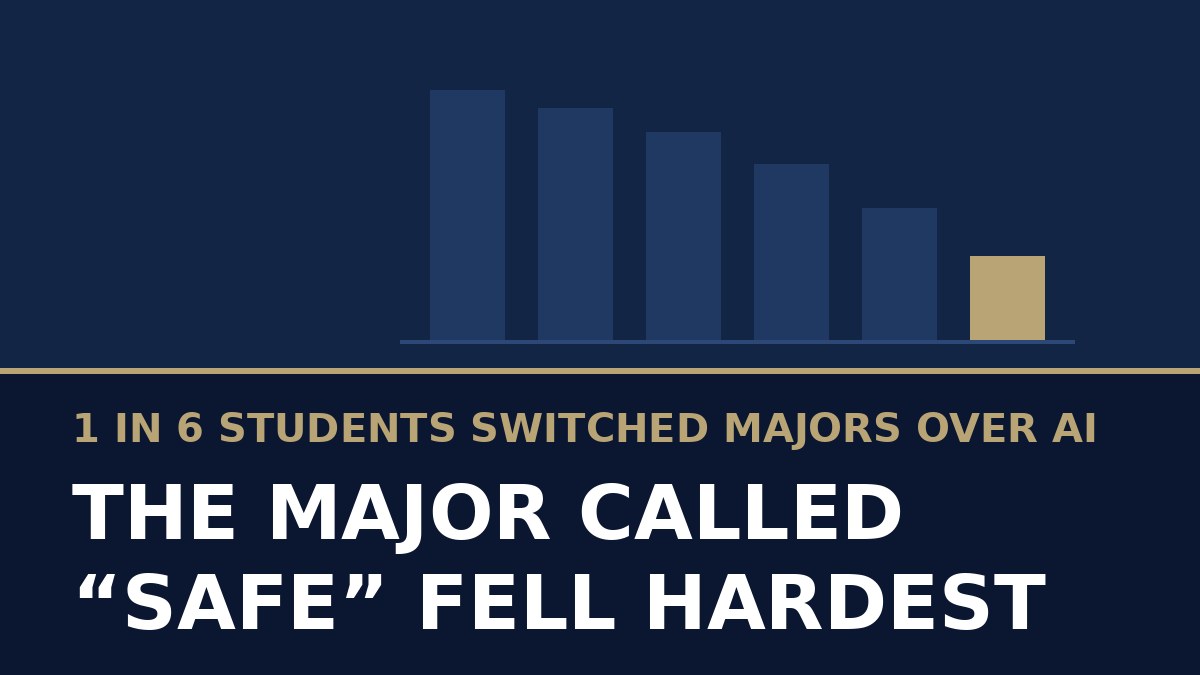
In a Gallup study for the Lumina Foundation, 16% of enrolled US college students — about 1 in 6 — said they have already changed their major or field of study because of AI, and 47% have given the switch at least "a fair amount" of thought. A separate June–July 2026 survey of 2,000 students commissioned by Superhuman (formerly Grammarly) found 69% worry AI will make finding a job harder, and 22% have changed majors or concentrations over job-market fears.
The "safe" major cracked first
After roughly 15 years as one of America's fastest-growing majors — four-year computer science degrees quintupled from 2008 to 2024 — CS enrollment fell 8.1% in fall 2025, from about 659,700 undergrads to 606,100. That is the steepest one-year drop of any field since at least 2020. Graduate enrollment fell 14%, and CS slipped from the 4th-largest undergraduate major to 6th in a single year. Stanford economist Jacob Light confirms it is the first enrollment decline in about two decades — while cautioning the data cannot prove AI caused it.
The Future of AI in Marketing. Your Shortcut to Smarter, Faster Marketing.

This guide distills 10 AI strategies from industry leaders that are transforming marketing.
Learn how HubSpot's engineering team achieved 15-20% productivity gains with AI
Learn how AI-driven emails achieved 94% higher conversion rates
Discover 7 ways to enhance your marketing strategy with AI.
Students are not fleeing tech — they are moving sideways
Engineering enrollment rose 7.3% (mechanical +11.4%, electrical +13.8%). And AI itself became a destination: only 4 US schools offered an AI degree in 2020; Northeastern researchers now count 79 with a major and 100+ with a minor. MIT's AI major, launched in 2022, is already its second-most-popular program. At the far end of the spectrum, Arizona State now offers a Bachelor of Arts in Content Creation — an influencer degree, capstone measured in real followers.
The part the panic gets wrong
The St. Louis Fed found that between April 2023 and late 2025, youth unemployment rose 2.9 percentage points from plain job scarcity — and 1.1 points from employers shifting toward AI skills. In the Fed's words, AI is "an additional headwind" for new grads, but smaller than the broader hiring slowdown. Recent-grad unemployment still stood at 5.6% in December 2025, against roughly 4.2% for workers overall.
So what should anyone study? OpenAI's education VP Leah Belsky told Axios that employers will hire for transferable skills — critical thinking, AI literacy, leadership, collaboration — not a magic "AI-proof" major. The degree matters less than whether you can use these tools with judgment.
The takeaway, whether you are 19 or 49: the anxiety is rational, the damage is smaller than the headlines, and the winning move is not guessing the un-automatable major — it is pairing a field you actually like with real fluency in the tools everyone will be expected to use.
The site version adds an interactive breakdown of every number in this story, the full sourced proof table, and a copy-paste prompt — The Major Stress-Test — that interviews you (or your student) and maps exactly where a degree's value sits against AI.
Read less. Know more.

Morning Brew delivers the biggest stories in business, finance, and tech in about 5 minutes — with just enough personality to keep things interesting.
Join 4,000,000+ professionals who start their mornings a little smarter.
— Jerry