
Wispr Flow turns your voice into clean, ready-to-send writing — speak naturally, it strips the filler and fixes the punctuation. I've used it daily since February 2026 to build this newsletter. Read the full review →
The AI buildout just got a price tag: $1 trillion next year.
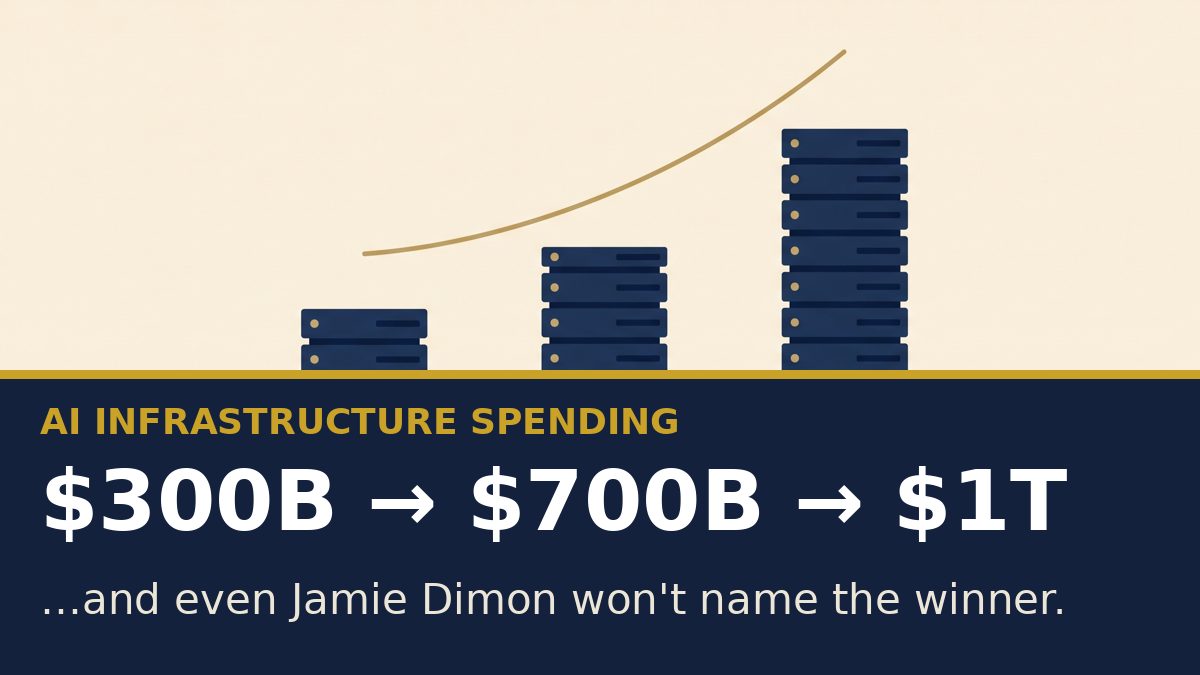
On Monday, Jamie Dimon — who runs JPMorgan Chase, the biggest bank in America — said spending by the big cloud companies and their suppliers went from about $300 billion last year to about $700 billion this year, and could reach $1 trillion in 2027. “That’s like 1% increase to GDP each year,” he told CNBC-TV18.
Then he said the part that matters more: it is too early to know who wins.
The math holds up
The U.S. economy produced about $30.8 trillion in 2025, so 1% is roughly $300 billion. Going from $300 billion to $700 billion is $400 billion of new spending in one year — about 1.3% of the whole economy.
Other counts point the same way. S&P Global Ratings projects six companies alone — Alphabet, Amazon, Microsoft, Meta, Oracle and SpaceX — at about $870 billion this year and more than $1.3 trillion in 2027. And government data shows it on the ground: in the second quarter, inflation-adjusted U.S. spending on computers and data-center hardware ($752 billion) edged past residential investment ($748 billion). America now spends more building computers than building homes.
Free email without sacrificing your privacy

Gmail tracks you. Proton doesn’t. Get private email that puts your data — and your privacy — first.
What Dimon was careful about
He called AI an “unbelievable technology” and said the expansion looks set to continue. He also said it may add a little to inflation in the short run, that heavy borrowing is pushing interest rates up, and that there may be a market correction — though he wasn’t sure AI would cause it. On whether companies can prove a return, he said sometimes it’s simply “table stakes.”
His reference point for who wins was the internet bubble, when many famous names failed and little-known companies became the giants. That history has a useful detail: in the late 1990s, telecom companies laid fiber-optic cable around the world, and many went bust — Global Crossing filed for bankruptcy in January 2002. The cable stayed, and became part of the cheap bandwidth the modern internet runs on. The builders lost; the users won.
The warning signs are already visible. S&P says the spending is growing faster than revenue and expects these six companies to spend more than their operations bring in during 2026 and 2027. And 64% of registered voters in a recent NBC News poll said they’d be less likely to back a candidate who supports a data center in their community.
What it means for you
Your AI tools should keep getting cheaper and better. Overbuilt capacity tends to reward the people renting it.
Your bills may feel it first: a little more inflation now, and upward pressure on interest rates.
Your retirement account is probably already in the bet. In an S&P 500 index fund, Microsoft, Alphabet, Amazon and Meta are among the largest holdings. Not a reason to buy or sell — a reason to know what you own.
Who spends the most isn’t who wins. Watch who turns the spending into things people pay for.
On the site: an interactive chart of the buildout, the source behind every number, and a copy-paste prompt that maps where the trillion touches your bills, your work, your savings and your tools.
How 2M+ Professionals Stay Ahead on AI
What’s the secret to staying ahead of the curve in the world of AI? Information.
Luckily, you can join 2,000,000+ early adopters reading The Rundown AI — the free newsletter that makes you smarter on AI with just a 5-minute read per day.
How was today's edition?
— Jerry
AI Super Simplified